Prisoners' Legal Services of Massachusetts
  • About
    • Our Mission
      Pharmacy Manchester United Kingdom
    • Our Priorities
    • Our History
    • Our Team
    • Contact Us
  • Services
    • Individual Advocacy
    • Impact Litigation
    • Community Engagement
    • Policy Advocacy
    • Systemic Advocacy
  • Projects
    • Immigrant Detention Conditions Project
    • Racial Equity in Corrections Initiative
    • Prison Brutality Project
    • Women’s Project
  • Resources
    • Media & Public Outreach
    • PLS Blog
    • PLS Notes
  • Get Involved
    • Pro Bono
    • Events
    • Join Our Team
    • Join Our Email Lists
  • Menu Menu
Find Help Donate

Prisoners’ Legal Services of Massachusetts Statement on Governor Baker’s Latest Amendments to Incarceration-Related Bills 

July 29, 2022

Prisoners’ Legal Services of Massachusetts Statement on Governor Baker’s Latest Amendments to Incarceration-Related Bills 

Governor Baker is refusing to sign a law that would provide free calls in prisons and jails, holding it hostage to try to force passage of a “dangerousness” bill that would expand pre-trial incarceration.  This is unconscionable.  Removing charges from prison phone calls will help keep prisons safer, give children and loved ones of those in prison a lifeline, and help incarcerated people succeed when they reenter our communities. 

Expanding the reach of incarceration will not improve safety.  Many incarcerated people are survivors of violence both prior to and during their imprisonment.  We deeply respect the lived experiences of survivors and see the ways in which incarceration compounds trauma and destroys communities and connection that are critical for public safety and violence prevention.  

Addressing violence requires building strong communities, and no cost calls are critical to keep families and communities connected during the trauma and separation of incarceration. Shame on Governor Baker for threatening this important achievement in the name of public safety. 

We thank Chairs Day and Eldridge and the Judiciary committee for listening to survivors and those impacted by violence and listening to prison families who desperately need communication. We call on Governor Baker to stop holding No Cost Calls hostage and sign it into law. We also urge legislators to do all in their power to pass no cost calls without weakening the language, and to reject Governor Baker’s proposed dangerousness provisions. 

http://plsma.org/wp-content/uploads/2025/07/logo.png 0 0 Valerie http://plsma.org/wp-content/uploads/2025/07/logo.png Valerie2022-07-29 18:52:152022-07-29 18:52:15Prisoners’ Legal Services of Massachusetts Statement on Governor Baker’s Latest Amendments to Incarceration-Related Bills 

Prisoners’ Legal Services of Massachusetts Statement on the  2021-2022 Legislative Session Budget

July 20, 2022

Prisoners’ Legal Services of Massachusetts Statement on the  2021-2022 Legislative Session Budget

On Monday, July 18th, the Massachusetts legislature voted on the state’s budget, which was passed by both the House and Senate. The budget currently sits before Governor Baker for his final approval. There are multiple items in this year’s budget that will improve the lives of incarcerated people and their families in Massachusetts. PLS is grateful for the policymakers who advocated for these changes and the organizations, coalitions, and individuals who have been fighting for this change. Many of these victories are the result of years of dedicated organizing and advocacy and are promising steps on the road to abolishing all harms of the carceral system.  

Elimination of Probation and Parole Fees 

Governor Baker’s decision to forward the elimination of probation and parole fees helps alleviate an unnecessary financial burden on formerly incarcerated people who are reentering society. These fees impact tens of thousands of people, disproportionately people of color, in Massachusetts annually and are essentially a regressive tax imposed under the guise of public safety. We praise this decision and hope it is the first reform of many improving the state’s broken parole system.  

No Cost Calls 

PLS is grateful for Senator Creem, Representative Tyler, and all the legislators who worked to eliminate charges for phone calls and other communications for incarcerated people. Sheriffs and the Department of Correction (DOC) are required by the budget language to maximize access to telephones, and if they do as required, incarcerated people will be able to strengthen their family and community connections. This will alleviate a tremendous financial burden for disproportionately impoverished individuals and families. It has also been shown that increased contact with family promotes successful reentry.   

PLS will advocate that the DOC and the Sheriffs are required to expeditiously and sufficiently implement changes, must improve upon currently available access to telephones, and may not add further obstacles to communications for incarcerated people. The African American Coalition Committee at MCI-Norfolk has called for providing universal access to tablets and allowing unlimited telephone calls to be made via the tablets from 6:00 am to 11:30 pm. This is a reasonable and readily available mechanism that would help fulfill the legal mandate to maximize communication access and ensure the legislative intention to strengthen community connections is fulfilled. PLS strongly supports this call, and we also call on the DOC and the Sheriffs to implement telephone access through tablets as soon as possible.

Commissary Reforms  

Senator Creem’s provision ending commissions on commissary items, limiting prisons and jail commissary pricing to 3% above their cost, and requiring gender-affirming and culturally appropriate items is a major improvement for the physical and financial well-being of incarcerated people. PLS’ Racial Equity in Corrections Initiative (REICI) previously identified the lack of culturally appropriate commissary items as a major issue among our clients. Commissaries provide goods necessary for daily living for prisoners and we praise reforms that make these goods more accessible and affordable. 

Decarceration 

The inclusion of a COVID-19 related decarceration mandate in the DOC budget line item, led by Senator Chang-Diaz, is a major victory for every incarcerated person in the commonwealth. With over a million deaths in the United States alone, the COVID-19 pandemic has presented an unprecedented challenge to public health. Considering that incarcerated people are 5.5 times more likely to contract COVID-19 than the general population, incarcerated people have been devastated by this virus for years. Sadly, this reflects the poor health outcomes and unique vulnerabilities experienced by people in our prisons and jails. We applaud the legislature’s decision to increase the use of alternatives to incarceration to appropriately balance public safety needs against the imminent public health threat of COVID-19, and we call on the DOC to finally implement this mandate, which has been on the books since FY 2020. 

In addition to the legislators mentioned in the letter above, we’d like to thank Senate President Spilka, Speaker of the House Mariano, the chairs of the Ways and Means committee, Senator Rodrigues and Representative Michlewitz, and the members of the Criminal Justice Reform Caucus. We look forward to continuing our collaboration with the legislature to improve the lives of incarcerated people and their families. Each of these budget items represents material improvements for some of Massachusetts’ most vulnerable communities. Thank you again to the countless people who made these victories possible.  

http://plsma.org/wp-content/uploads/2025/07/logo.png 0 0 Valerie http://plsma.org/wp-content/uploads/2025/07/logo.png Valerie2022-07-20 19:56:012022-07-20 19:56:01Prisoners’ Legal Services of Massachusetts Statement on the  2021-2022 Legislative Session Budget

Advocates call for end to men being sent to correctional facilities for substance abuse treatment

April 22, 2022

Advocates call for end to men being sent to correctional facilities for substance abuse treatment

GBH
By Esteban Bustillos
April 20, 2022

Advocates are calling for the end of a Massachusetts policy that allows men to be put in correctional facilities when they are involuntarily commited for treatment of substance use disorder.

The practice, which is allowed under a statute known as Section 35, ended in 2016 for women but is still in place for men. Under Section 35, “qualified petitioners” such as spouses, blood relatives, doctors and police officers can request a court order to commit someone to treatement.

According to the Prisoners’ Legal Services of Massachusetts, around 38 states allow people suffering from substance use disorder to be civilly committed, but Massachusetts is the only state that allows them to be held in prison.

As debate quickly approaches for the state’s next annual budget, experts and advocates are calling for the state to strip correctional facilities of their funding under Section 35 and invest in other treatment options.

Read more…

http://plsma.org/wp-content/uploads/2025/07/logo.png 0 0 Valerie http://plsma.org/wp-content/uploads/2025/07/logo.png Valerie2022-04-22 18:33:042022-04-22 18:33:04Advocates call for end to men being sent to correctional facilities for substance abuse treatment
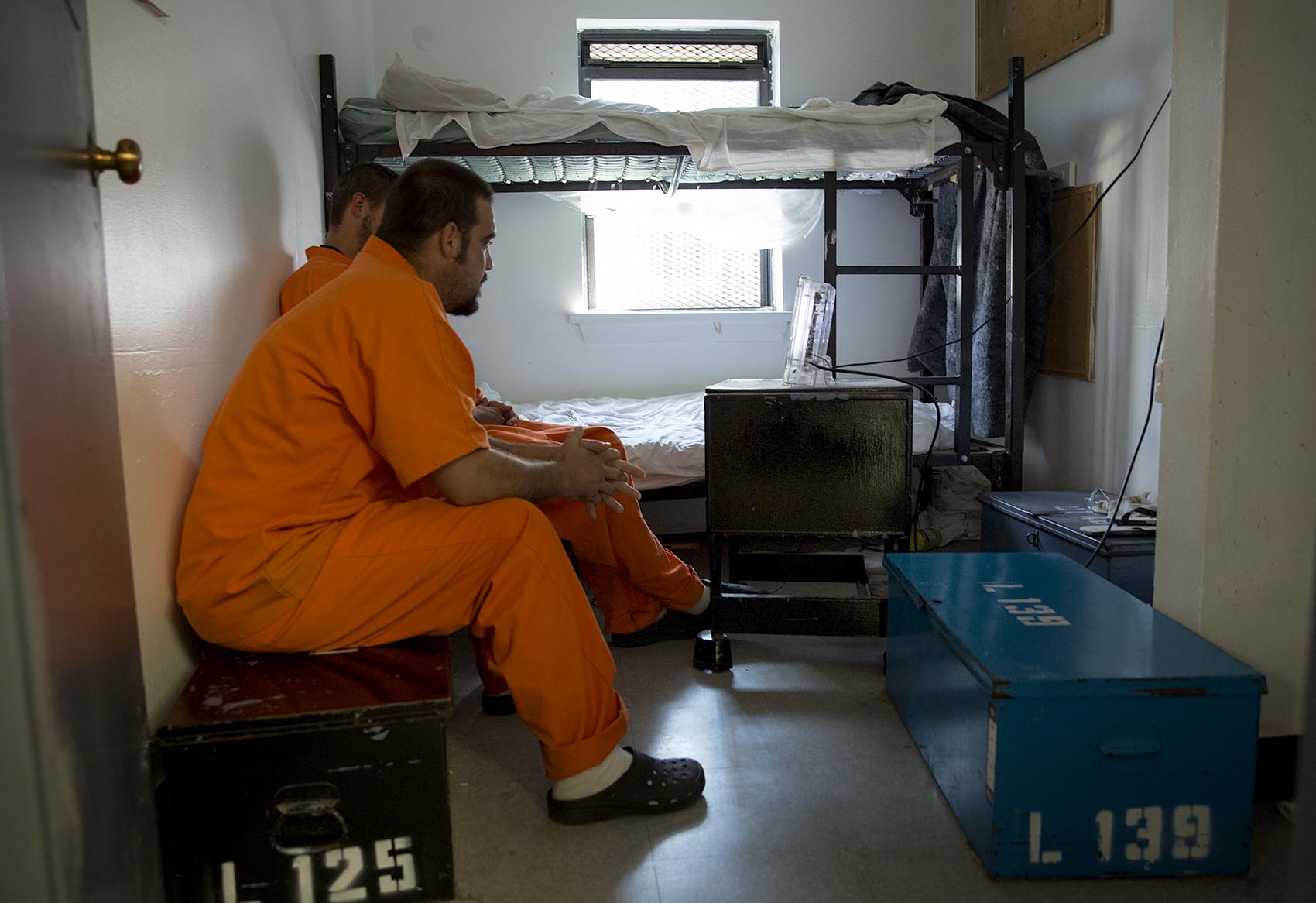
Patients at MASAC at Plymouth live in two bunk rooms in three "dorms." Two men in Dorm A watch television to pass the time. (Robin Lubbock/WBUR)

Mass. legislators debate whether to fund addiction programs that lock people up

April 22, 2022

Mass. legislators debate whether to fund addiction programs that lock people up

Patients at MASAC at Plymouth live in rooms with two bunks each. (Robin Lubbock/WBUR)

WBUR
By Deborah Becker
April 21, 2022

Massachusetts lawmakers are debating whether to continue supporting programs that put people inside jails and prisons for addiction treatment.

Both Gov. Charlie Baker and the House leadership have proposed setting aside roughly $23 million in the budget for such addiction programs. But State Rep. Ruth Balser has filed budget amendments to eliminate the funding and redirect it to community treatment programs.

Some advocates rallied outside the State House on Wednesday to urge lawmakers to halt funding the prison programs that commit people to addiction treatment inside correctional facilities.

Emily Smith, of Hingham, is among those who spoke out against the programs, sharing her personal experience with her brother.

Smith said she went to court earlier this year to commit her brother to treatment because she was concerned about his mental health and his drug use. But she didn’t realize he would be sent to the Plymouth County State Prison for treatment.

“The first time he called me days after being there he was so upset and so mad at us,” Smith said. “He said, ‘Why did you throw me in jail?’ “

Her brother, Chris Hiltz, said police arrested him while he was living in his car and took him to court. A judge then determined that his drug use was dangerous enough for an involuntary commitment. So, Hiltz said, he was shackled, handcuffed and transported to Massachusetts Alcohol and Substance Abuse Center at the Plymouth prison. While he was there, he said he received little help.

“The worst experience of my life,” said Hiltz, 35. “I’ll be honest, I’ve been to many detoxes. I’ve been to a lot of mental health places, but never in my life experienced this.”

Read more…

https://plsma.org/wp-content/uploads/2025/08/0831_plymouth-masac-01.jpg 1166 1700 Valerie http://plsma.org/wp-content/uploads/2025/07/logo.png Valerie2022-04-22 18:27:212025-08-19 16:17:37Mass. legislators debate whether to fund addiction programs that lock people up

Letter to the Massachusetts Senate Ways and Means Committee advocating for corrections & Sheriffs’ Departments budget accountability and transparency

February 11, 2022

This letter was submitted to the Massachusetts House and Senate Ways and Means Committees on January 31, 2022 to advocate building greater transparency and accountability into the Department of Correction (DOC) and Sheriffs’ Departments’ budgets. Substantial funding is allocated to incarceration each year despite a declining number of people in custody. With budget season kicking off, we are particularly concerned about the lack of effective solutions recommended by the Commission on Correctional Funding’s final report. The letter highlights that oversight is long overdue. 

January 31, 2022

Aaron Michlewitz, House Chair

Ann-Margaret Ferrante, House Vice Chair

Michael J. Rodrigues, Senate Chair

Cindy F. Friedman, Senate Vice Chair

Joint Committee on Ways & Means

Dear Chair Michlewitz, Chair Rodrigues, Vice Chair Ferrante, Vice Chair Friedman, and Committee Staff:

With budget season upon us, we write to ask that you build accountability measures into the budget line item for the Department of Correction (DOC) and Sheriffs’ Departments, such as breaking out funding for distinct purposes and spelling out consequences for failing to meet reporting requirements or other responsibilities.

We respectfully call your attention to the testimony submitted by organizations and individuals to the Commission on Correctional Funding in early January. Joint testimony submitted by 55 organizations raises important concerns about the substantial funding allocated to incarceration each year, given the declining numbers of people in custody and given the documented harms that incarceration inflicts on people in custody and their families and communities (please find all of the testimony here at the end of this page on the Commission’s website).

The Commission summarizes its two main motivations as controlling correctional costs and improving programming for people who are incarcerated. However, the only cost control idea the Commission recommends is to consider consolidating some housing units in prisons and jails – and that recommendation depends on successful implementation of a recommendation to improve data collection about such units. We are concerned that another call for data collection is going to be ineffective without strong independent oversight that has the authority to demand consistent and timely compliance from the DOC and Sheriffs’ Departments. Furthermore, the single biggest cost in both DOC and Sheriffs’ Departments is custody staff, a cost that is deeply impacted by contracts that guarantee minimum levels of correctional officer staffing regardless of the number of people in custody, an issue that has been paid little attention, and which is not included in the draft of the report currently available to the public. 

We also respectfully call your attention to the fact that the DOC and the Sheriffs successfully requested withholding of the staffing analysis overseen by the National Institute of Corrections (NIC). Only brief summaries of 1-4 pages are available on the Commission’s website of these self-directed projects. Even the Commission members, to our knowledge, have not seen the full analysis. The public and the Legislature should be skeptical of any recommendations based on this analysis, unless the full methodology and results are made public.

Related, the Commission appears to accept that implementation of Chapter 69 (the Criminal Justice Reform Act of 2018) has resulted in increased costs because some prisons and jails have implemented one to two additional hours of out-of-cell time for people in solitary confinement, and the CJRA requires programming in restrictive housing units – instead of understanding these costs as a result of continued overreliance on segregation. As we know, most programming stopped during the pandemic. Moreover, the aim of criminal justice reform is to keep as many people in the general population as possible, not to build up a new infrastructure of indefinite segregated confinement.

At the Commission meeting on January 26, the second meeting to discuss the draft report, Sheriff Coppinger stated repeatedly that the prospect of a new proposed agency to standardize reporting and programming “scare[d]” him (this discussion begins around 53 minutes into this recording). After much discussion of Sheriff’s resistance to an “outside, independent” agency, the report was changed to recommend a new “structure” which might take any of several forms, including leaving it to the same DOC and Sheriffs’ Departments that have already failed to deliver on standardization, reporting, transparency, and accountability.

We also want to alert you to the way the Commission uses the term “programming” to refer to mental health and substance use treatment and other clinical services, which are properly understood as medical care. We are greatly concerned that this blurring of terms obscures the true level of spending on programs, such as education and vocational training, and also elides the constitutional obligation to provide medical care. Even with the conflation of these terms, we can see from the bar charts in the report that only a very small percentage of correctional spending goes to programming (as little as two percent, with a range of $1000-$7000 per person per year), yet the report includes no consideration of how funds could be re-allocated to increase programming access while reducing and controlling costs. We also question why the Commission omitted any discussion of the benefits of free communication between people who are incarcerated and their loved ones, when we know that maintaining family and community ties is so important and so cost-effective.

Another glaring omission is any recommendations to accelerate the downward trend in the numbers of people incarcerated, including maximizing the mechanisms the Commonwealth already has at its disposal to release and divert people, and considering reforms currently on the table that would also assist with safe and responsible depopulation. Massachusetts has an extraordinarily high proportion of elderly and infirm people living in prison; this population poses little threat to public safety, and the costs of incarcerating them are high, and increasing.

Finally, we are troubled by the new Common Cause report identifying ethically suspect campaign contributions that may be influencing Sheriffs’ decisions about vendors, contracts, and therefore use of the budget that this body provides.

We would welcome the opportunity to meet with you and your staff to discuss these issues. We can recommend reallocation of funds within the budget, areas for empirical research to inform decision-making, and how the budgeting process can bring needed oversight to the DOC and Sheriffs’ Departments.

Thank you for your attention to this letter. We look forward to hearing from you.

Sincerely,

Jesse White, Policy Counsel, Prisoners’ Legal Services

Mary Valerio, Actual Justice Task Team, United Church of Christ

Rachel Roth, Independent Researcher and Consultant

http://plsma.org/wp-content/uploads/2025/07/logo.png 0 0 Valerie http://plsma.org/wp-content/uploads/2025/07/logo.png Valerie2022-02-11 16:16:452022-02-11 16:16:45Letter to the Massachusetts Senate Ways and Means Committee advocating for corrections & Sheriffs’ Departments budget accountability and transparency

STATEMENT BY PRISONERS’ LEGAL SERVICES IN SUPPORT OF MEDICAL PAROLE

February 10, 2022

STATEMENT BY PRISONERS’ LEGAL SERVICES IN SUPPORT OF MEDICAL PAROLE

February 10, 2022

In light of the news conference today about “ending the medical parole loophole for murderers,” Prisoners’ Legal Services of Massachusetts would like to address misperceptions surrounding the medical parole process and highlight the importance of ensuring access to it.

In 2018, the Massachusetts Legislature enacted the medical parole statute as part of the Criminal Justice Reform Act, requiring the Department of Correction (DOC) and Sheriffs to release certain qualifying prisoners who are terminally ill or permanently incapacitated and who do not pose a risk to public safety. In doing so, the Legislature recognized that the continued incarceration of extremely ill prisoners would increasingly burden taxpayers and compromise the health and safety of the most fragile people in custody. This is particularly true now due to the current COVID-19 pandemic.

While the medical parole statute brought Massachusetts closer in line with the compassionate release policies of other states, eligible prisoners continue to face significant barriers to the medical parole process that prevent them from petitioning for or receiving the relief to which they are entitled. Massachusetts should look to fully effectuate the medical parole statute from 2018 to improve access to alternatives to incarceration rather than championing measures to curtail it.

When the medical statute was passed, excluding prisoners serving life sentences was specifically considered and decided against. The same should happen now. Aging prisoners, who are often the ones most suited to medical parole, are frequently serving life sentences without the possibility of parole. At the beginning of 2020, over 1,000 prisoners were serving life sentences without parole in Massachusetts, more than half of whom were aged 50 or over. Allowing these individuals to age and ultimately die in the custody of the DOC, which is ill-equipped to provide the costly medical care and accommodations they need, is simply bad policy. Condemning someone to life-without-parole may seem like justice, but real justice centers healing, not retribution.

The public safety mechanisms built into the statute already set an extremely high bar for release. Under the medical parole statute, individuals must be either terminally ill or permanently incapacitated, and in either case, so debilitated that they do not pose a risk to public safety. In addition to the individual risk assessments DOC is required to conduct on all potential medical parolees, studies indicate that the rate of recidivism falls dramatically as individuals age, and that it is almost 0% for individuals over the age of 65.

Moreover, Massachusetts taxpayers would be required to shoulder the ever-increasing costs required to maintain a constitutionally-adequate level of care, as healthcare costs make older prisoners multiple times more expensive to incarcerate than younger ones.

The story below further illustrates the importance of improving access to medical parole:

Mr. Smith is a 56-year-old African American man who was serving a natural life sentence. He became a quadriplegic during the crime for which he was incarcerated. During his decades of incarceration, his physical condition sharply declined due to lack of care such that he was totally bedridden and suffers from contractures so severe that staff are unable to move his body into a sitting position. In early 2020, DOC granted Mr. Smith medical parole (which PLS had petitioned for immediately after the medical parole law passed in 2018), clearing the way for his transfer to a placement in a facility. On August 5th, 2021, after years of ongoing advocacy efforts and court actions, Mr. Smith was finally transferred to a care facility.

The shortcomings of the medical parole process can best be addressed by current legislation pending in the state house, bill H. 2448 and S. 1599. This bill would remove obstacles to the medical process by clarifying eligibility determinations, providing access to cognitively incapacitated persons, ensuring a clear path to placement of eligible prisoners, and encouraging prompt resolution of court challenges to denials. You can learn more about this legislation here.

http://plsma.org/wp-content/uploads/2025/07/logo.png 0 0 Valerie http://plsma.org/wp-content/uploads/2025/07/logo.png Valerie2022-02-10 16:09:432022-02-10 16:09:43STATEMENT BY PRISONERS’ LEGAL SERVICES IN SUPPORT OF MEDICAL PAROLE

Hearing shows setting matters for addiction, mental health care

November 9, 2021

Hearing shows setting matters for addiction, mental health care

State House News/MassLive
November 9, 2021
By Katie Lannan

BOSTON (SHNS) – Two sets of elected officials on Monday offered different visions on the role of correctional facilities in addiction treatment, an issue that has become part of the public debate over how to respond to the substance use and homelessness crises at Boston’s Massachusetts Avenue and Melnea Cass Boulevard.

Five years after a state law ended the practice of sending women to prison when they were civilly committed for addiction treatment, bills filed by Rep. Ruth Balser and Sen. Cindy Friedman aim to do the same for men subject to so-called Section 35 civil commitments.

Meanwhile, a Sen. Nick Collins bill lays out a procedure for handling Section 35 petitions when courts are closed, in which a justice could temporarily commit a person facing a “grave likelihood of serious harm,” with a hearing to be held on the next business day. His bill also would establish that “correctional facilities operated by the Suffolk County Sheriff shall be permitted to enter into agreements with approved section 35 facilities to provide public health services at the same level of care.”

Bonnie Tenneriello of Prisoners’ Legal Services said most Section 35 beds for men are run by the Department of Correction and the Hampden County Sheriff’s Office, and said that those facilities still feel like jails to the people who reside there.

“It reinforces the perception that they are second-class citizens who deserve no better than jail. This is profoundly countertherapeutic and directly undermines any chance for successful treatment and recovery,” she said.

Read more…

http://plsma.org/wp-content/uploads/2025/07/logo.png 0 0 Valerie http://plsma.org/wp-content/uploads/2025/07/logo.png Valerie2021-11-09 20:36:042021-11-09 20:36:04Hearing shows setting matters for addiction, mental health care

Thursday hearing will tackle Massachusetts bill that would provide free phone calls from prisons and jails

October 22, 2021

Thursday hearing will tackle Massachusetts bill that would provide free phone calls from prisons and jails

The Berkshire Eagle
October 21, 2021
By Danny Jin

Working for $5 per week while behind bars, Jasmin Borges could afford just one 20-minute phone call with her daughters each week.

“When I came home 12 years later, nothing could prepare me for the cold, dark truth that I didn’t know my daughters,” Borges said at an Oct. 4 legislative hearing. “I had to learn my daughters. I had to learn their personalities, their likes and dislikes.”

Borges, now an organizer for the Massachusetts Bail Fund, was one of more than 25 speakers at the hearing who advocated for a bill that would make phone calls free for people incarcerated in Massachusetts. A similar bill was on the slate for a Thursday hearing by the Legislature’s committee on public safety and homeland security. The new hearing begins at 10 a.m. and can be accessed at malegislature.gov/Events/Hearings/Detail/3990.

“If the state and counties believe in rehabilitation, they must pay for the treatment and programs in prison, not extract that money from prison families who cannot afford it and have to ration their calls because [costs are] so inflated,” Bonnie Tenneriello, a staff attorney for Prisoners’ Legal Services of Massachusetts, said at the Oct. 4 hearing.

Read more…

http://plsma.org/wp-content/uploads/2025/07/logo.png 0 0 Valerie http://plsma.org/wp-content/uploads/2025/07/logo.png Valerie2021-10-22 15:08:082021-10-22 15:08:08Thursday hearing will tackle Massachusetts bill that would provide free phone calls from prisons and jails

DAY-LONG HEARING ON CORRECTIONS SEES PLEAS FOR FREE CALLS AND AN END TO LIFE W/OUT PAROLE

October 7, 2021

DAY-LONG HEARING ON CORRECTIONS SEES PLEAS FOR FREE CALLS AND AN END TO LIFE W/OUT PAROLE

DIG Boston
October 7, 2021
By Jean Trounstine

On Tuesday, Oct. 5, a legislative hearing held by the Joint Committee on the Judiciary highlighted the work activists across Massachusetts are doing to end racism and injustice in the criminal legal system.

One-hundred sixty people, representing more than 60 grassroots organizations, signed up to testify on at least one of 50-plus bills concerning “Correctional Services & Sentencing.” 

Four bills garnered the most attention, focusing on issues covered in depth by DigBoston and the Boston Institute for Nonprofit Journalism in previous reporting: the campaign for free phone calls behind bars, as well as those to end the sentence of life without parole (LWOP), revise conditions of parole supervision, and stop the building of new prisons and jails.

In a remote hearing that lasted eight-and-a-half hours, along with 15 state lawmakers and other officials, members of the public testified for three minutes each about why bills should or should not become law. Joint Senate and House committees require public hearings for bills that they consider.

Free calls

Attorney Bonnie Tennerielo said that in 2018, prisoners in Massachusetts, a “largely Black and brown and low income” population,” “spent $25,000,000 to keep in touch with loved ones.” The Prisoners’ Legal Services lawyer notes that “$7,000,000 of those monies were in “commissions” which were “really just kickbacks…the phone companies take this money from consumers and give it right back to the prisons and jails.” An Act relative to telephone service for inmates in all correctional and other penal institutions in the Commonwealth, filed by Rep. Chynah Tyler, demands “voice communication service free of charge” instead of what is an average of 14 cents per minute consumers are paying in Mass. prisons and jails.

Read more…

http://plsma.org/wp-content/uploads/2025/07/logo.png 0 0 Valerie http://plsma.org/wp-content/uploads/2025/07/logo.png Valerie2021-10-07 17:50:392021-10-07 17:50:39DAY-LONG HEARING ON CORRECTIONS SEES PLEAS FOR FREE CALLS AND AN END TO LIFE W/OUT PAROLE

Lessons from ‘The taking of Cell 15’: Reform corrections

August 23, 2021

Lessons from ‘The taking of Cell 15’: Reform corrections

August 22, 2021
The Boston Globe
By The Editorial Board

The story of “The taking of Cell 15″ at Souza-Baranowski, the state’s maximum security prison, isn’t just about its two occupants on that January day, it’s about a prison system that prefers gag orders to transparency, where those with a badge and a taser get to make the rules and truth remains elusive.

Even as the state and its localities strive to bring policing into the 21st century, the Massachusetts correctional system is stuck in another age. Prison guards have tough, dangerous jobs. But abuses do happen, and when they do, prison inmates can’t take to the streets to demand justice. All they can do is file internal grievances or occasionally get word to a lawyer.

Their options are few, their influence virtually nonexistent. It’s easy to forget those behind bars, and so they are at the mercy of a closed system that protects its own. And that has to change. It’s time to reimagine corrections just as this state has begun to reimagine policing, and to establish a safer environment for both inmates and officers.

Read more…

http://plsma.org/wp-content/uploads/2025/07/logo.png 0 0 Valerie http://plsma.org/wp-content/uploads/2025/07/logo.png Valerie2021-08-23 16:53:092021-08-23 16:53:09Lessons from ‘The taking of Cell 15’: Reform corrections
Page 1 of 3123

Questions?

If you have additional questions or concerns that you would like assistance with, please call us during our intake hours on Monday (or Tuesday if Monday is a holiday) from 1:00pm – 4:00pm.

Contact Us

Get Involved | Find Help | Donate

© 2025 Prisoners’ Legal Services of Massachusetts | Privacy Policy | Racial Equity Statement
Website by Compete Now

Get Involved | Find Help | Donate

  • About
    • Our Mission
      Pharmacy Manchester United Kingdom
    • Our Priorities
    • Our History
    • Our Team
    • Contact Us
    • Back
  • Services
    • Individual Advocacy
    • Impact Litigation
    • Community Engagement
    • Policy Advocacy
    • Systemic Advocacy
    • Back
  • Projects
    • Immigrant Detention Conditions Project
    • Racial Equity in Corrections Initiative
    • Prison Brutality Project
    • Women’s Project
    • Back
  • Resources
    • Media & Public Outreach
    • PLS Blog
    • PLS Notes
    • Back
  • Get Involved
    • Pro Bono
    • Events
    • Join Our Team
    • Join Our Email Lists
    • Back
  • Find Help
  • Donate
  • As of February 1, 2026, PLS has a new address located on a different floor in the same building.

    Our new address is:

    Prisoners’ Legal Services
    50 Federal Street, 7th Floor
    Boston, MA 02110

    Any mail already in transit will be forwarded. Thank you!