
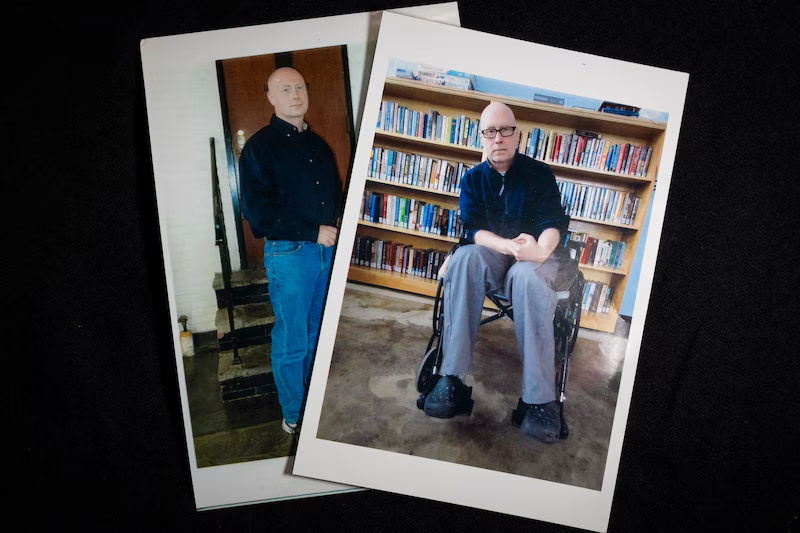
‘The worst nursing home’: Medical parole remains out of reach for many in Mass. prisons
“Death Under Watch” is an ongoing series by MassLive and The Republican investigating deaths in Massachusetts prisons and jails.
After more than a decade in prison, James Keown had remained relatively healthy — something he did not take for granted.
But in 2020, his health began to decline. His body weakened, he developed muscle problems and he eventually needed a walker. The cause of his condition was unclear, setting him on a years‑long struggle to find answers.
Keown, 51, is incarcerated at MCI-Shirley in a medical unit. He’s one of more than 700 people who have applied for medical parole in Massachusetts since the state enacted the law in 2018, seeking compassionate release. He has been denied several times.
“I was committed by the courts to serve a sentence for my crime,” Keown said. “I was not sentenced to a crushing and progressive disability that was arguably preventable if not for the department’s delays and inability to provide adequate access to care.”
Read more:
- Mercy delayed, mercy denied: How Mass. medical parole leaves many to die in prison
- Massachusetts could reform medical parole law amid system criticisms
Keown has sounded the alarm about the health care he received while incarcerated, an experience he wrote about in a 2023 essay published in The Marshall Project.
Jordan Gomes, who was incarcerated until late 2024, previously worked as a medical companion for Keown inside prison and saw him miss outside medical appointments because of issues such as prison staffing.
“Prison is like the worst nursing home ever,” Gomes said, “as far as the hospital units go.”
MassLive and The Springfield Republican found that from fiscal years 2018-2024, 91 of the 677 prisoners who applied for medical parole, about 14%, were granted release. Lawmakers on Beacon Hill are working to revamp the state’s medical parole system just eight years in. Some of the measures include quickening the process, giving weight to home care settings and allowing a judge to overturn the release decision, which is now made solely by the commissioner.
In a statement, a spokesperson for the Department of Correction said the agency “remains deeply committed to providing comprehensive health services to the approximately 6,000 incarcerated individuals in our care. In correctional settings, the success of the rehabilitative mission relies on a system’s ability to provide quality and compassionate care.” A DOC spokesperson declined to make Commissioner Shawn Jenkins available for an interview.

‘The guy is not a safety risk’
For years, doctors suspected Keown had a neurological disorder. Today, he can’t walk and uses a wheelchair. He uses oxygen to supplement his breathing and has braces on his wrists because he can’t control them. He also uses a voice amplifier because he is weak, according to Jack Godleski, his medical parole attorney.
Recently, Keown was officially diagnosed with functional neurological disorder, a condition in which brain signals aren’t being sent correctly, causing symptoms like muscle issues and seizures.
He’s struggled to swallow food, shave himself and use a pen, court documents say.
“The guy is not a safety risk,” Godleski said. “He’s just not.”
His crime, though, didn’t require much physical strength. Keown is serving a life sentence without the possibility of parole for fatally poisoning his wife with antifreeze in 2004. In 2021, then-Department of Correction Commissioner Carol Mici wrote that she saw him as a risk to public safety. The family of his victim wrote to the commissioner opposing his release.
“This man is an evil, lying, deceitful, hateful, jealous, and murderous excuse of a human being, if you can even call him that,” they wrote.
While chronically ill and incarcerated, Keown has struggled to get the care he needs, he and his attorney say. He waited more than a year to get an appointment with an outside neurologist, Godleski said. When that doctor sent back health care plans to the DOC with future appointment dates and test orders, the DOC did not make the appointments, Godleski contends.
Recently, in March, Keown was able to go to physical and occupational therapy at an outside hospital, but it was months after his original appointment was canceled by the DOC, he said.
The DOC said it cannot discuss details on specific individuals and medical care due to HIPAA privacy rules.

Suffering until conditions become ‘irreversible’
Emory Snell, 69, is incarcerated at MCI-Shirley for first-degree murder in the slaying of his wife on Cape Cod in 1995. His initial medical parole application was denied last year. He is appealing the decision.
Godleski, also Snell’s attorney, described his client as “wheelchair-mandated with limited mobility, hearing impaired and suffering from a life-threatening cardiac condition, multiple respiratory ailments and life-altering orthopedic problems.”
Snell has to be pushed around the prison in his wheelchair by a fellow prisoner, and he uses a CPAP machine and four different prescription respiratory inhalers, according to his medical parole appeal.
A Navy veteran who is eligible for full VA benefits upon his release, Snell said his original hope was to get a bed at the Veterans Home at Chelsea. His health has “rapidly deteriorated” under prison health care, he said.
He says the care makes prisoners suffer until their conditions become “irreversible.”
Snell isn’t alone. A recent survey by the Boston College Legal Services Lab of incarcerated women at MCI-Framingham found one of the most consistent concerns was “the negligent, coercive and punitive nature of the medical care provided by the contractor VitalCore and managed by DOC.”
VitalCore Health Strategies, which is under a five-year, $770 million contract with the DOC, referred all questions for this story to the DOC.
The DOC spokesperson said in a statement that the agency works in close partnership with VitalCore “to address the challenges of caring for a population that often has complex and significant health needs.”
The DOC has a health services division of licensed medical and behavioral health care professionals who are “dedicated to monitoring contract compliance, conducting frequent audits, and ensuring adherence to the national accreditation health care standards established by the American Correctional Association,” the spokesperson wrote.
Prisoners who are trained and paid by the DOC to serve as companions in the prison medical units for people like Keown and Snell have a front row seat to the deterioration of ailing individuals.
“I’m dubbed the companion of death,” Alex Delgado told lawmakers during a hearing in October, referring to his role caring for dying prisoners. Until recently, his job was to spend time with prisoners who are severely ill, keeping them company and helping them with basic tasks like making their beds or pushing their wheelchairs.
“Patients speak with me about their past,” he said. “They repeat the same stories, forgetting the many times I’ve heard them. These patients are bedridden, their dialogue (is) between breaths of supplemental oxygen machines. Imagine a time when you’re unable to recognize how to use toilet paper. These are my patients.”
He’s watched people die who’ve been granted medical parole but didn’t get released in time.
“I see me in that bed,” said Delgado, who is serving a life sentence without the possibility of parole for his involvement in a 1992 Springfield murder. If he becomes sick one day, he hopes someone will do the job for him, “or God will take into consideration I wasn’t a piece of s*** my whole life” and let him die peacefully.
Freedom in her final days
Brenda Brousseau had been granted what Keown and Snell seek when she recorded video testimony in support of proposed legislation to change the law. She’d been incarcerated for more than 30 years, serving a life sentence for her involvement in a 1990s murder.
Brousseau applied for medical parole multiple times and Prisoners’ Legal Services sued trying to get her released. She was unable to shower or use the bathroom by herself, largely depending on a wheelchair, and had kidney disease and heart failure, court documents say.
After multiple tries, she was ultimately releasedunder parole supervision.
“We need to get out of there. Please, please. I beg of you,” she said in her video testimony about prison, speaking with a tube in her nose and the hum of what sounds like medical machines in the background. “I can’t stress on you (enough), it’s horrible … It’s barbaric.”
A few months later, Brousseau died. She was still on supervised parole, but spending her last days outside prison walls brought her some solace.
“She expressed a simple and profound joy about being able to get crochet needles in her nursing home room,” said Mallory Hanora, executive director of Families for Justice as Healing, an organization that advocates for women incarcerated at MCI-Framingham. “She also was comforted by having a staff around her whose job it was to care for her, not punish her.”