
Mercy delayed, mercy denied: How Mass. medical parole leaves many to die in prison
“Death Under Watch” is an ongoing series by MassLive and The Republican investigating deaths in Massachusetts prisons and jails.
Access the article here.
After diabetes forced the amputation of his right leg last year, Howard Payne got worse news: A tumor on his kidney and liver looked malignant.
A doctor working for the Department of Correction (DOC) submitted a medical parole petition on his behalf, saying Payne was terminally ill. But like most incarcerated people who apply for medical parole under a state law, mercy remained out of reach.
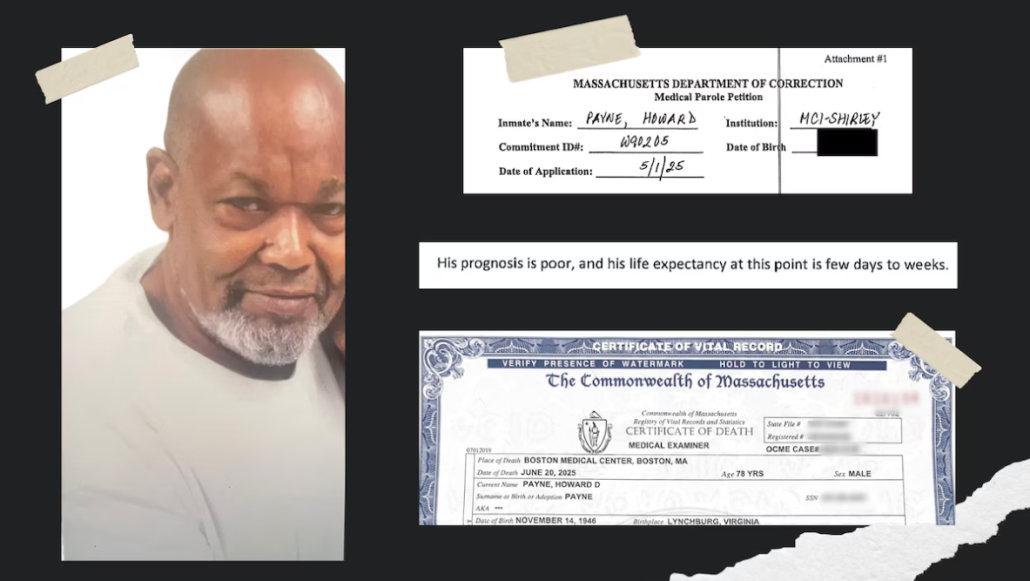
And so Payne lay dying – shackled to a bed at Boston Medical Center, while legal advocates begged the DOC to expedite his medical parole application. His organs were shutting down, and he had days to weeks to live, a doctor determined. That failed to hasten the process. He died at 78 last June.
“It was so obvious this man was on death’s door when I met him. It was mind-blowing he was still in custody,” saidJack Godleski, his attorney. Payne was barely conscious when Godleski visited him in the hospital.
An 8-year-old law allows for compassion in situations like Payne’s, but it’s desperately hard to find, an investigation by MassLive and The Springfield Republican found.
Some might argue Payne didn’t deserve to die free because of his crime, a 2006 shooting in Mattapan that killed a 37-year-old man. Payne was convicted of second-degree murder.
But in 2018, Massachusetts offered a glimmer of relief for sick people in prison. The state was one of the last in the U.S. to adopt a medical parole law. It offers compassionate release to incarcerated people who are dying or permanently incapacitated and are no longer considered a threat to others.
The measure, however, hasn’t worked in many cases. Some people have died waiting for a response, while others granted parole died still in custody.
In the first eight years of the program, most petitions were denied.
- Read more: Massachusetts could reform medical parole law amid system criticisms
- ‘The worst nursing home’: Medical parole remains out of reach for many in Mass. prisons
One person – the commissioner of the Department of Correction — decides whether to grant the petition. While it’s possible to appeal in court, a judge can’t overturn the commissioner’s decision. Sometimes, even when an inmate is released, it can be a long process that leaves family wondering if their loved one could have gotten better care sooner.
A DOC spokesperson declined to make Commissioner Shawn Jenkins available for an interview. They would only answer questions submitted in writing.

Department of Correction Commissioner Shawn Jenkins speaks to incarcerated individuals at North Central Correctional Institution in Gardner in Jan. 2025. (Department of Correction) (Department of Correction)
The department has to weigh whether, if paroled, the person would pose a safety risk, the spokesperson said in a statement.
“In every case, the Department carefully evaluates the individual circumstances, including public safety considerations, victim input as required by law, and the statutory and regulatory criteria governing medical parole.”
Concerns about the current system have caught the attention of some legislators and activists who are fighting to change the law.
There appears to be momentum – some of their proposed measures, such as giving a judge some power in the parole decision and creating a path to an expedited process, were reported favorably out of committee on Beacon Hill in January to each body’s Ways and Means committees.
Between fiscal years 2018 and 2024, fewer than 14% of the 677 prisoners who applied were granted release, according to analysis by MassLive and The Republican. People of color are significantly less likely to be released compared to their white counterparts, the analysis shows. The state has not released its report on fiscal year 2025.
Last year, six people died while a request or appeal was pending. Three people who were granted medical parole died before they were released, according to public records obtained by Prisoners’ Legal Services. It’s not uncommon: the nonprofit has represented a dozen people who died while their medical parole applications were pending.
James Ware was granted medical parole in January but died before his release. (Amy Belger)
In early April, 52-year-old James Ware, serving life without parole for first-degree murder, died in prison custody even though he had been granted medical parole in January. His attorney said the process of finding a suitable place for his release was arduous and protracted.
Like Payne and Ware, some who apply are incarcerated for the most serious crimes.
“This is really where the rubber hits the road in terms of what are the boundaries of our compassion,” said Godleski. The Greenfield attorney handles medical parole cases statewide and teaches a course on compassionate release at Boston University School of Law.
The problem is likely to worsen. Massachusetts’ prison population, while overall relatively small compared to other states, is rapidly aging. Percentage-wise, it’s one of the oldest in the country.
“The DOC is not a department that was intended to be nursing homes and deal with end-of-life care. That is complicated and hard,” said state Rep. Lindsay Sabadosa, D-1st Hampshire, whose legislation proposes changes to medical parole. “It has a real economic expense on the commonwealth.”

State Representative Lindsay Sabadosa speaks during a meeting at the Northampton Senior Center in 2023. (Don Treeger / The Republican) (Don Treeger / The Republican)
The DOC says it is “deeply committed” to providing health care to prisoners and that its services meet the American Correctional Association standards.
“We continue to work in close partnership with our contracted medical provider to address the challenges of caring for a population that often has complex and significant health needs.”
Some prisoners with certain health issues are held in medical units in the prisons, while those who need more intensive inpatient care often go to Lemuel Shattuck Hospital in Jamaica Plain. The DOC estimates it costs about $600,000 per year to house one incarcerated person there.
That’s compared to between $85,000 and $215,000 to house a prisoner in typical prison settings in Massachusetts. According to MassHealth, the state’s Medicaid program, it costs less than $200,000 per year to house someone in a nursing home.
There’s a moral cost, too, advocates say.
“When a person is dying, continued incarceration actually serves no purpose. It’s just cruelty,” said state Sen. Liz Miranda, D-2nd Suffolk, while speaking in October at a hearing on Senate legislation she’s sponsoring to make it easier to get released on medical parole.
If Payne had been paroled, he wouldn’t have rejoined “normal” life or done any of the things he’d longed for in isolation. Like eating at Tahiti’s in Dedham, his favorite Chinese restaurant, or cooking lobster and crab with his family. Mostly, he wanted to hold his grandchildren, the youngest of whom he’d never met. A little girl he called “baby boogums.”
Payne’s release after 20 years in prison would have meant his final breaths could have been taken in a care facility of his family’s choosing, with them by his side. He would have died a free man — an unrealized possibility that haunts his daughter, Syreeta Arisme.
How medical parole works in Massachusetts
Massachusetts adopted a medical parole law in 2018, when it passed a criminal justice reform bill that included the provision.
Since then, about 100 people have been released under the law, with the highest number, 26, paroled in 2020 amid the COVID-19 pandemic.
Between fiscal years 2018-2024, according to the most recent data the state has released, about 15% of white applicants were approved, compared to 10% of people of color who petitioned.
Since a boom in applications during the pandemic, fewer people have applied in recent years, and the acceptance rate has increased. But the sheer number of people granted medical parole each year has dropped consistently over the last few years.
If released, the person remains under parole supervision through the end of what their sentence would have been. If they violate parole or their health condition improves so much that they are no longer eligible, they can be sent back to prison or jail. Between fiscal years 2018-2024, four people released were sent back, according to annual reports. The reasons they were sent back are not included.
Mirroring the demographics of the prison system, the vast majority of those who have been released are men. The state incarcerates a little over 200 women at MCI-Framingham, compared to more than 5,600 men at its other facilities.

MCI-Framingham is the Massachusetts prison for women. (Courtesy)
From 2018 to mid-2025, four women were approved while 38 women were denied, and one died before the DOC made a decision, according to data from public records obtained by Families for Justice as Healing and shared with MassLive and The Republican.
Showing someone is not a risk is “an uphill battle,” said Frank R. Herrmann, a Boston College Law School professor emeritus the crime occurred who has represented people seeking compassionate release.
“The people I’ve represented are all doing life sentences. They are probably the most scrutinized if they were to be released for medical reasons,” he said.
In a statement, a DOC spokesperson said that the agency’s policy dictates the use of a standardized risk assessment tool, and consideration of a long list of factors, including the diagnosis, the person’s mobility and how well they can manage daily activities.
Some advocates and lawyers say the DOC commissioner relies too heavily on a person’s crime when evaluating risk, even when the crime occurred decades ago.
They describe people with severe dementia and others with limited mobility as being evaluated as too dangerous.
“If you can’t go up a single stair,” Godleski, the Greenfield attorney, said, “I don’t see how there could be a safety risk. I guess reasonable minds can differ.”
Herrmann had a client with progressive paralysis who couldn’t walk a few feet without falling over, who was deemed a threat to public safety if released.
“It’s a difficult situation to persuade an authority where someone is doing a life sentence that he is not a threat to society any longer,” Herrmann said.
The determination on whether someone is a risk to public safety is “inconsistent and shrouded in mystery,” said Dr. Nicole Mushero, a geriatrician at Boston Medical Center who has volunteered to review medical records for prisoners applying for release. In her reviews, she saw people being denied and didn’t understand why.
So she and a team of researchers analyzed 31 petitions filed by Prisoners’ Legal Services and found no correlation between the Department of Correction’s recidivism risk score, calculated by a standardized test, and whether people were released. The decisions did correlate with recommendations from the prison superintendent, who reviews the case before the commissioner. The study’s findings were published in Nature, a scientific journal late last year. Petitions are generally not public records, but the legal services nonprofit allowed the researchers to review the cases PLS submitted.
“Getting released even at the very end of life can have quality of life differences for the person dying,” Mushero said.
Part of that is access to better health care, advocates say. VitalCore, the Kansas-based for-profit company providing health care for the DOC referred all questions for this story to the DOC. The company, which has faced litigation across the country related to its care of incarcerated people, is in the midst of a five-year, $770 million contract with Massachusetts.
“Most of the time, what we see are people who are having huge delays in their care and very poor communication,” said Dr. Alice Bukhman, an emergency medicine physician and head of medical partnerships at Prisoners’ Legal Services. “Folks who are diagnosed with cancer, it takes, instead of two weeks, two months to get them biopsied and along the pathway.”
Some see medical parole as a ‘loophole’
Anyone, regardless of their sentence, can apply for medical parole. That angered some families of first-degree murder victims when the law was enacted. They called it a “loophole” because the conviction often carries an automatic life-without-parole sentence.

Maureen Moriarty speaks as Hampden District Attorney Anthony Gulluni looks on at a 2022 press conference. Moriary’s father, John Regan, was murdered in 1995 and his killer, John Stote, was granted medical parole. (Don Treeger/The Republican) (Don Treeger/The Republican)
Maureen Regan Moriarty, whose father was murdered in Springfield in 1995, was appalled when her father’s killer, John Stote, was released on medical parole in 2021 after he was determined to be permanently incapacitated.the
“The law was on our side. Until this law was not,” she said at a 2022 press conference. Stote is still alive and under the supervision of the Parole Board.
Hampden District Attorney Anthony D. Gulluni believes people with life sentences without parole for first-degree murder should not be allowed to access medical parole.
“Those sentences were lawfully imposed after lengthy trials that considered the graveness of the defendant’s behavior,” he said in a recent statement. “While the statutory intent of this law is to afford compassion to inmates, the compassion and consideration owed to crime victims and their families should not become any less important.”
Having the head of a correctional system decide who receives medical parole is not common, according to Mary Price, senior counsel at Families Against Mandatory Minimums, which has been analyzing medical parole laws nationwide. All states but a few have medical parole laws, and it’s generally more common that a parole board, rather than one individual, makes the final decision, she said.
If denied, an individual can file a petition in the Superior Court, but it’s an “almost toothless process,” Godleski said.

Greenfield Attorney John “Jack” R. Godleski stands for a portrait outside the Northampton District Court on Wednesday. Jan. 21, 2026. (Douglas Hook / The Republican)
That’s because the court can’t compel a prisoner’s release. A 2023 Massachusetts Supreme Judicial Court decision holds that courts lack authority to overturn the commissioner’s medical parole decision. A judge can only tell the commissioner to reconsider.
That “eviscerated” the law, said Ruth Greenberg, a Swampscott attorney. She has worked on many medical parole cases, including the petition of Alexander Phillips, the first person in the state granted compassionate release under the 2018 law.
It’s possible the SJC decision will be overturned, she said, but it left her disheartened.
“There’s no remedy,” she said. “It’s entirely discretionary with the commissioner.”
That’s one issue pending legislation on Beacon Hill aims to address.
Howard Payne’s story
Payne, a self-described former drug dealer who changed his life through faith, was known for mentoring boys and young men on Boston’s streets, according to a 2006 Boston Globe story.
When interventions failed, he often paid for flowers at funerals, a youth worker told the Globe.
Before his murder charge, Payne owned Jubilee Auto Services, a gas station and car dealership on River Street between Mattapan and Hyde Park. That’s where he met Ismael DelValle and his wife in 2005. Payne later told authorities he sold the couple a car.
In 2006, when he was 59 Payne shot and killed DelValle. Payne had been friends with DelValle’s wife, which caused tension between the married couple, according to a summary of Payne’s criminal case from the state Parole Board. After an argument at a Mattapan home between DelValle and his wife, Payne shot him. DelValle had three children and two stepchildren; attempts to reach his family members for this story were unsuccessful.
During his trial, Payne claimed he acted in self-defense and that he thought DelValle had a gun. That didn’t convince a jury: In 2007, Payne was convicted of second-degree murder and sentenced to life in prison. He left many children and grandchildren on the outside.

MCI-Shirley in Shirley, Massachusetts is a medium-security prison. (Massachusetts Department of Correction)
Syreeta Arisme was especially close with her father, and they spoke on the phone nearly every day. She mailed him photos of her kids each week.
Payne entered prison as a diabetic. In 2021, while at MCI-Shirley, he experienced excruciating pain in his foot.He recounted what happened next in an interview with another incarcerated man, Wayland Coleman, who posted the audio on YouTube.
Payne worried that if he didn’t have part of his toe removed, the infection would spread up his foot and leg.
“I took a razor blade and cut it around at the knuckle,” he told Coleman in the interview. “All that meat I just took off and threw it over the toilet.”
The DOC couldn’t confirm any details of that story due to HIPAA privacy laws and a spokesperson said the department is unable to comment on individual medical cases.
Several years later, nearing the spring of 2025, it was the same leg that needed to be amputated.
Payne’s leg was infected and had gangrene, a condition in which, the tissue dies and can lead to sepsis. While incarcerated, he had already had several toes removed for similar reasons in addition to the story about him attempting to cut off one of his own.
Doctors also found what they suspected to be a malignant tumor on Payne’s kidney and liver.
His leg was amputated at Boston Medical Center in April 2025. He was then transferred to Lemuel Shattuck Hospital, run by the state Department of Public Health and used by the DOC for intensive care.
Dr. Maria Angeles – a doctor for VitalCore Health Strategies, the private company the DOC contracts with for health care – submitted a medical parole petition on his behalf in early May. She checked boxes on the application that noted he was terminally ill and permanently incapacitated.
In her medical assessment, Angeles wrote that Payne refused a biopsy on what doctors believed to be deadly tumors, so he didn’t have a formal diagnosis of a terminal illness. But with health problems stacking up, she wrote, his life expectancy was less than 18 months, which is what the law defines as terminally ill. Angeles blamed Payne’s complications on “years of poor medication and treatment compliance.” She wrote he was known to not follow his diabetes treatment and “rarely” went in for blood sugar checks or insulin.
Arisme said the diabetes care provided to her father in prison was poor.
In Payne’s medical parole case, his victim’s family requested a hearing, a mechanism available in cases involving murder convictions. Jenkins, the DOC commissioner, scheduled Payne’s hearing for June 25 and said he would make a decision by early July, according to a notice he wrote dated June 10.
Arisme didn’t think her father would make it to the hearing.
Payne’s heart was functioning at a fraction of its normal capacity, Arisme wrote in a June 14 letter to Jenkins, urging his release before he died. His family wanted to choose where he received his final medical care and be by his side.
Because he was still in DOC custody, visiting was possible, but restricted. Under department policy, visits to hospitalized incarcerated people at Shattuck are limited to one hour per week during certain periods, restricted to two people per day and must be scheduled in advance.
The DOC can loosen the rules for anyone “in imminent danger of death, or seriously ill,” the policy says. How often that happens and what that looks like is not clear. When asked about visiting rules for hospitalized inmates, a DOC spokesperson pointed to the written policy.
“Granting medical parole would allow my father to pass away with dignity, surrounded by love of his children, sisters and grandchildren,” Arisme wrote, “and would provide our family with the opportunity to say a final, peaceful goodbye. This would be a profound act of humility during an incredibly difficult time.”
Days later, Prisoners’ Legal Services wrote to Jenkins saying that Payne had a life-threatening infection in the intensive care unit and was on the verge of being put on a ventilator. The organization noted “his time was near” and asked that his restraints be removed.
With septic shock, his organs shutting down and suspected malignant cancer, his life expectancy was days to weeks, a doctor at Boston Medical Center wrote in a June 19 letter.
Arisme said her father could barely recite a Bible scripture, and described his cough as a “death rattle.”
The pleas from Payne’s family, doctors and lawyers didn’t persuade the commissioner to expedite the proceedings.
“They didn’t care,” Arisme said of the DOC. “It was just like, to hell with him. He’s just another Black man that’ll just die with no dignity.”
On June 20, Payne’s family members from Virginia came to visit him at Boston Medical Center. After they left, Arisme said he died that afternoon.
She is clear that her dad’s choices that led to prison were wrong.
“I have empathy for that family,” she said. “Nobody’s life should be taken away … not a soul,” she said. But she still felt her father should have been treated with more respect and dignity at his most vulnerable time.

The death certificate of Howard D. Payne, who was convicted of the murder of Ismael DelValle in 2007 and died while awaiting medical parole last year. (Douglas Hook / The Republican)
One of the images that won’t leave her is Payne with one of his legs and arms each shackled to the hospital bed, even when he was unconscious. The restraints were taken off for a few days, she believes, because of his medical treatment.
But when Arisme went to visit him the day before he died, he was shackled again, she said.
“Why did you put it back on him?” she asked the guards. “I said, you know, he can’t go anywhere. What are we gonna push him through the ICU doors, through the guards and the elevator? We’re gonna push him out the window?”
She said she begged the guards, but they were told it was their job to keep him restrained.
It’s DOC practice that at an outside hospital, incarcerated people have at least one limb shackled to the bed, said Lauren Petit, a Prisoners’ Legal Services staff attorney and the organization’s medical parole project director. “That is true even if they’re unconscious or intubated,” she said. “We’ve had a number of people die in that circumstance.”
The DOC did not respond to a public records request submitted in November asking for the department’s policy on restraining prisoners while hospitalized.
A department spokesperson said in a statement that they could not comment on hospital security rules because “these policies contain sensitive security measures which could be exploited to facilitate an escape, disrupt the orderly operation of a hospital and possibly jeopardize the safety of the public, the housed individual and DOC staff.”
Dr. Catharina Armstrong, a doctor at Newton-Wellesley Hospital who previously worked at Lemuel Shattuck Hospital for a decade, has seen firsthand the barriers to visiting people who are incarcerated and hospitalized. She remembers treating an incarcerated man with colon cancer in his 30s.
The man had been denied medical parole multiple times, she told legislators at a hearing in October. When he had just hours left to live, Armstrong met with his mother
“His mother only wished to be at his bedside when he passed,” Armstrong said. She was told by the DOC she could have eight minutes.
“She was ordered to leave the bedside at exactly eight minutes, and he died 30 minutes later, alone. I spent the rest of the evening with the mother trying to make sense of this cruel and unusual set of circumstances, which made the most devastating moments of her life even that more painful.”
Payne’s official cause of death was cardiovascular disease. His death certificate lists pneumonia, diabetes and metastatic cancer as contributing conditions.
In a DOC document logging deaths last year, which MassLive and The Republican obtained through a public records request, Payne’s death is listed as “expected.”
“I miss my dad so, so much,” Arisme said. “Yeah, I miss him so much.”
In prison with dementia
Even when someone is released on medical parole, it can be a long and arduous process that leaves family wondering what may have happened if their loved one had been paroled sooner. That was the case for Jose Hernandez.
Originally from Puerto Rico, Hernandez later moved to Lawrence. In 2009, he shot a man during an argument over drugs. He was sentenced to life in prison without the possibility of parole for first-degree murder,.
His daughter, Ana Maria Hernandez, said she was concerned when he started calling her from prison a few years ago and was not making any sense. He’d call her, saying he heard she had died in the woods, she said.
“All these crazy phone calls,” she said. “I’m like, what is going on?”
She was told her dad had dementia. Prison staff would find him soaked in his own urine, nude in the bathroom in the middle of the night and wearing his underwear on the outside of his pants, Petit, the Prisoners’ Legal Services attorney, wrote in a letter to the DOC alongside his initial medical parole application. At times, he didn’t know where he was.
He couldn’t count to 20 and was unable to draw a basic clock, according to a 2024 evaluation from Bukhman. Her independent report, submitted as part of his medical parole application, concluded he was severely cognitively impaired.

When Jose Hernandez, left, was evaluated for dementia, he was asked to draw a clock showing “10 past 11.” The image on the right is what he drew. (Courtesy)
The DOC commissioner denied his first application for medical parole in October 2024. A DOC doctor tested him for dementia and found he had severe cognitive decline, though he was determined to be medically stable. His recidivism risk, including for violent crime, was determined to be low, according to a DOC report.
“That is very common – people will have a low score and get denied anyway,” Petit said.
In his denial, Jenkins wrote that Hernandez’s condition was not so debilitating that he did not pose a public safety risk, which is what the law requires. The prison superintendent also noted Hernandez’s medical assessment didn’t say he was incapable of criminal activity, and recommended against his release. The Essex County District Attorney, the office that prosecuted him, also opposed his petition.
Over the next year, Petit filed multiple reconsideration requests for his medical parole until, in June 2025, the commissioner approved the request.
What changed? “My honest answer is nothing, but if you ask DOC, they would definitely say his health deteriorated,” Petit said. “We have that frustrating question in many of these. Our feeling was the person was eligible from the first date of the petition, if not before.”
MassLive and The Republican asked about Hernandez’s case, and a DOC spokesperson said the department can’t comment on an individual’s medical history.
Getting approval for parole was only part of the battle. Where he would go was the next problem. None of his family members were in Massachusetts and his daughter lived about two hours away in New Hampshire.
A family member who worked as a certified nursing assistant in Florida was ready to quit her job to take Hernandez in and care for him around the clock. Petit proposed this plan to the DOC, but it denied the request, requiring him to go to a skilled nursing home.
Finding a placement for someone on parole can be a challenge, Petit said. Hernandez was ultimately placed in a Holyoke facility.
“I don’t understand, because if someone’s leaving on medical parole, don’t they need emotional support from family?” Hernandez asked. She was the geographically closest family member, and coming to visit from two hours away was not easy for her, given her job running a daycare and caring for her own two young children.